
Date: January, 2
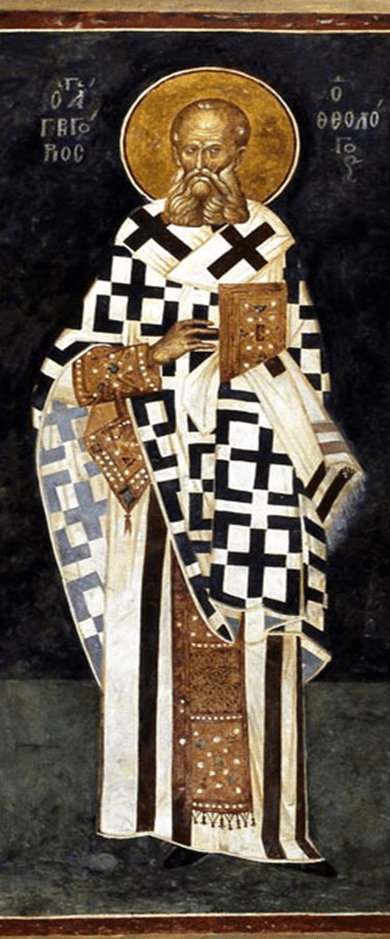
Doctor of the Church, born at Arianzus, in Asia Minor, c. 325; died at the same place, 389. He was son — one of three children — of Gregory, Bishop of Nazianzus (329-374), in the south-west of Cappadocia, and of Nonna, a daughter of Christian parents.
The saint’s father was originally a member of the heretical sect of the Hypsistarii, or Hypsistiani, and was converted to Catholicity by the influence of his pious wife.
His two sons, who seem to have been born between the dates of their father’s priestly ordination and episcopal consecration, were sent to a famous school at Caesarea, capital of Cappadocia, and educated by Carterius, probably the same one who was afterwards tutor of St. John Chrysostom.
Here commenced the friendship between Basil and Gregory which intimately affected both their lives, as well as the development of the theology of their age.
From Caesarea in Cappadocia Gregory proceeded to Caesarea in Palestine, where he studied rhetoric under Thespesius; and thence to Alexandria, of which Athanasius was then bishop, through at the time in exile.
Setting out by sea from Alexandria to Athens, Gregory was all but lost in a great storm, and some of his biographers infer — though the fact is not certain — that when in danger of death he and his companions received the rite of baptism.
He had certainly not been baptized in infancy, though dedicated to God by his pious mother; but there is some authority for believing that he received the sacrament, not on his voyage to Athens, but on his return to Nazianzus some years later.
At Athens Gregory and Basil, who had parted at Caesarea, met again, renewed their youthful friendship, and studied rhetoric together under the famous teachers Himerius and Proaeresius.
Among their fellow students was Julian, afterwards known as the Apostate, whose real character Gregory asserts that he had even then discerned and thoroughly distrusted him.
The saint’s studies at Athens (which Basil left before his friend) extended over some ten years; and when he departed in 356 for his native province, visiting Constantinople on his way home, he was about thirty years of age.
After his baptism at 30, Gregory gladly accepted his friend Basil’s invitation to join him in a newly founded monastery. The solitude was broken when Gregory’s father, a bishop, needed help in his diocese and estate.
It seems that Gregory was ordained a priest practically by force, and only reluctantly accepted the responsibility. He skillfully avoided a schism that threatened when his own father made compromises with Arianism.
At 41, Gregory was chosen suffragan bishop of Caesarea and at once came into conflict with Valens, the emperor, who supported the Arians. An unfortunate by-product of the battle was the cooling of the friendship of two saints.
Basil, his archbishop, sent him to a miserable and unhealthy town on the border of unjustly created divisions in his diocese. When protection for Arianism ended with the death of Valens, Gregory was called to rebuild the faith in the great see of Constantinople, which had been under Arian teachers for three decades.
Retiring and sensitive, he dreaded being drawn into the whirlpool of corruption and violence. He first stayed at a friend’s home, which became the only orthodox church in the city. In such surroundings, he began giving the great sermons on the Trinity for which he is famous.
In time, Gregory did rebuild the faith in the city, but at the cost of great suffering, slander, insults, and even personal violence. An interloper even tried to take over his bishopric.
His last days were spent in solitude and austerity. He wrote religious poetry, some of it autobiographical, of great depth and beauty. He was acclaimed simply as “the Theologian.” St. Gregory Nazianzen shares the celebration of his liturgical feast with St. Basil the Great on January 2.
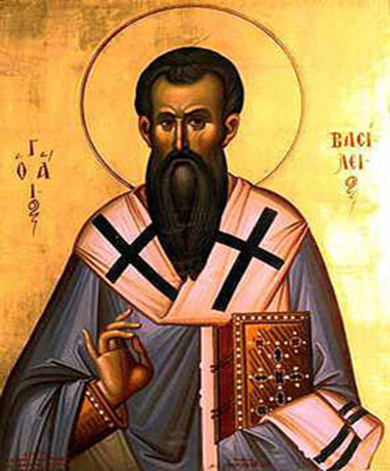
St. Basil the Great was born at Caesarea of Cappadocia in 330. He was one of ten children of St. Basil the Elder and St. Emmelia. Several of his brothers and sisters are honored among the saints.
He attended school in Caesarea, as well as Constantinople and Athens, where he became acquainted with St. Gregory Nazianzen in 352. A little later, he opened a school of oratory in Caesarea and practiced law.
Eventually he decided to become a monk and found a monastery in Pontus which he directed for five years. He wrote a famous monastic rule which has proved the most lasting of those in the East. After founding several other monasteries, he was ordained and, in 370, made bishop of Caesaria.
In this post until his death in 379, he continued to be a man of vast learning and constant activity, genuine eloquence and immense charity. This earned for him the title of “Great” during his life and Doctor of the Church after his death.
“A tree is known by its fruit; a man by his deeds. A good deed is never lost; he who sows courtesy reaps friendship, and he who plants kindness gathers love.”
― Saint Basil
PRAYER:
Saints Gregory and Basil, you were called by God to be a light in the midst of darkness during a time of great turmoil within the Church. Please pray for me, that I will never live enveloped in the darkness of this world but will always carry the light of Christ to scatter falsehood and sin, so that God may be glorified and souls may be saved. Saints Basil and Gregory, pray for me. Jesus, I trust in You.


Leave a comment