
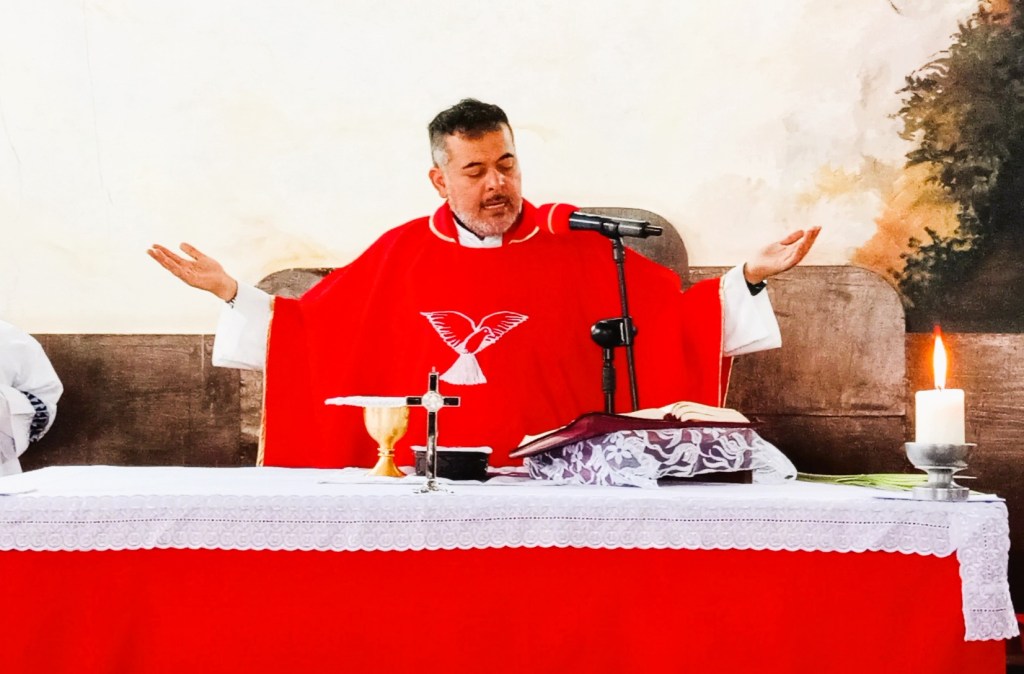
In the Roman Catholic Church, Mass starts with Introductory Rites (Entrance/ procession, greetings, Penitential Act, Glory to God, and the Collect Prayer) and ends with the Concluding Rites (Optional announcements, Greeting and Blessing, Dismissal). The Mass is divided into two main parts: (1) Liturgy of the Word (2) Liturgy of the Eucharist.
(1) The Liturgy of the Word includes First Reading, Responsorial Psalm, Second Reading (on Sundays and solemnities), Gospel Acclamation, Gospel, Homily, Profession of Faith (on Sundays, solemnities, and special occasions), and Universal Prayers.
(2) The Liturgy of the Eucharist involves Presentation of the Gifts and Preparation of the Altar, Prayer over the Offerings, Eucharistic Prayer (Preface, Holy, Holy, Holy, including Consecration, Mystery of Faith, ending with Doxology) The Lord’s Prayer, Sign of Peace, Lamb of God, Communion, and Prayer after Communion: and dismissal.
Responses during Mass
Introductory Rites
All stand. The Priest approaches the altar with the ministers and venerates it while the Entrance Song is sung
Sign of the Cross
All make the Sign of the Cross as the Priest says:
In the name of the Father, and of the Son, and of the Holy Spirit.
Christians reply: Amen.
Greeting, The Priest greets the people:
The grace of our Lord Jesus Christ, and the love of God, and the communion of the Holy Spirit be with you all. OR. Grace to you and peace from God our Father and the Lord Jesus Christ. Or: The Lord be with you.
The people reply:
And with your spirit.
The Priest, or a Deacon may very briefly introduce the faithful to the Mass of the day.
Penitential Act
The Priest invites the faithful to the Penitential Act.
Priest: Brethren (brothers and sisters), let us acknowledge our sins, and so prepare ourselves to celebrate the sacred mysteries.
A brief pause for silence follows, and then one of the following Penitential Acts:
A. I confess to Almighty God…
B. Have mercy on us, O Lord.
C. You were sent to heal the contrite…
All say:
A. I confess to Almighty God and to you, my brothers and sisters, that I have greatly sinned, in my thoughts and in my words, in what I have done and in what I have failed to do, (Striking their breast, they say): through my fault, through my fault, through my most grievous fault; therefore I ask blessed Mary ever-Virgin, all the Angels and Saints, and you, my brothers and sisters, to pray for me to the Lord our God.
The absolution by the Priest follows:
May Almighty God have mercy on us, forgive us our sins, and bring us to everlasting life.
Response: Amen.
The Kyrie
The Kyrie, eleison (Lord, have mercy) invocations may follow:
P. Lord, have mercy / Kyrie, eleison.
R. Lord, have mercy/Kyrie, eleison.
P. Christ, have mercy/Christe, eleison.
R. Christ, have mercy/Christe, eleison.
P. Lord, have mercy/Kyrie, eleison.
R. Lord, have mercy/Kyrie, eleison.
The Gloria
Glory to God in the highest, and on earth peace to people of good will. We praise you, we bless you, we adore you, we glorify you, we give you thanks for your great glory, Lord God, heavenly King, O God, almighty Father. Lord Jesus Christ, Only Begotten Son, Lord God, Lamb of God, Son of the Father, you take away the sins of the world, have mercy on us; you take away the sins of the world, receive our prayer; you are seated at the right hand of the Father, have mercy on us. For you alone are the Holy One, you alone are the Lord, you alone are the Most High, Jesus Christ, with the Holy Spirit, in the glory of God the Father. Amen.
The Collect Prayer
The Priest says: Let us pray.
And all pray in silence with the Priest for a while. Then the Priest says the Collect prayer, at the end of which the people acclaim:
Amen.
The Liturgy of the Word
First Reading
To indicate the end of these readings, the reader acclaims:
The word of the Lord.
All reply: Thanks be to God.
Psalm
After the First Reading the psalmist or cantor sings or says the Psalm, with the people making the response.
Second Reading
On Sundays and certain other days there is a second reading. It concludes with the same responsory as above.
Gospel
Congregants stand to sing the Gospel Acclamation to welcome the Gospel. They remain standing in honour of the Gospel reading, the high point of the Liturgy of the Word. At the ambo, the Deacon, or the Priest says:
The Lord be with you.
The people reply: And with your spirit.
The Deacon, or the Priest: A reading from the holy Gospel according to one of the Gospels.
He makes the Sign of the Cross on the Book and, together with the people, on his forehead, lips, and chest.
At the same time, the people acclaim:
Glory to you, O Lord.
At the end of the Gospel, the Deacon, or the Priest, acclaims: The Gospel of the Lord.
All reply: Praise to you, Lord Jesus Christ.
After the proclamation of the Gospel the congregation sits.
The Homily
The Homily is a brief reflection about God’s word in our everyday life. At the end of the Homily, there is a brief silence for recollection. The congregation then stands and profess their faith.
Profession of Faith/ The Creed
On Sundays and Solemnities, the Profession of Faith or Creed will follow. During Lent and Easter Time, especially, the Apostles’ Creed is used.
The Prayer of the Faithful (Universal/ Bidding Prayers)
After each intention there is a pause while the faithful pray. The minister says:
Lord, hear us.
All reply: Lord Graciously Hear Us.
The Priest concludes the Prayer with a Collect Prayer. When the Liturgy of the Word has been completed, the people sit.
The Liturgy of the Eucharist
The Offertory
During the Offertory Song the faithful usually express their participation by making an offering, bringing forward bread and wine for the celebration of the Eucharist and perhaps other gifts to relieve the needs of the Church and of the poor. When he has received the bread and wine for the celebration, the Priest offers prayer of blessing quietly at the altar. Sometimes these prayers are said aloud. If the priest says the prayers aloud the assembly’s acclamation each time is
Blessed be God for ever.
The Priest completes additional personal preparatory rites, and the people rise as he says:
Pray, brethren (brothers and sisters), that my sacrifice and yours may be acceptable to God, the Almighty Father.
The people reply:
May the Lord accept the sacrifice at your hands for the praise and glory of His name, for our good and the good of all His Holy Church.
Then the Priest says the Prayer over the Offerings, at the end of which the people acclaim:
Amen.
The Eucharistic Prayer
Extending his hands, the Priest says:
The Lord be with you.
The people reply: And with your spirit.
The Priest, raising his hands, continues:
Lift up your hearts.
The people: We lift them up to the Lord.
The Priest, with hands extended, adds:
Let us give thanks to the Lord our God.
The people: It is right and just.
The Priest continues with the Preface.
It is truly right and just, our duty and our salvation, always and everywhere to give you thanks, Lord, Holy Father, Almighty and eternal God, through Christ our Lord. In Him you have been pleased to renew all things, giving us all a share in His fullness. For though He was in the form of God, He emptied Himself and by the blood of His Cross brought peace to all creation. Therefore He has been exalted above all things, and to all who obey Him, has become the source of eternal salvation. And so, with Angels and Archangels, with Thrones and Dominions, and with all the hosts and Powers of heaven, we sing the hymn of Your glory, as without end we acclaim:
The Priest concludes the Preface with the people singing or saying aloud
Holy, Holy, Holy Lord God of hosts. Heaven and earth are full of Your glory. Hosanna in the highest. Blessed is He who comes in the name of the Lord. Hosanna in the highest.
After the singing of the Sanctus the congregation kneels for the moment of the Eucharistic Prayer.
Priest says his part. After the words of Consecration the priest says:
The mystery of faith.
The people continue, acclaiming: We proclaim Your Death, O Lord, and profess Your Resurrection until You come again.
Or: When we eat this Bread and drink this Cup, we proclaim Your Death, O Lord, until You come again.
Or: Save us, Saviour of the world, for by Your Cross and Resurrection you have set us free.
Then the Priest alone continues. At the conclusion of the Eucharistic Prayer the Priest takes the chalice and the paten with the host and, raising both, he alone says:
Through Him, and with Him, and in Him, O God, Almighty Father, in the unity of the Holy Spirit, all glory and honour is Yours, for ever and ever.
All respond: Amen.
The Communion Rite
The Lord’s Prayer
The congregation stands and the Priest says:
At the Saviour’s command and formed by divine teaching, we dare to say:
Together with the people, he continues:
Our Father, who art in Heaven, hallowed be Thy name; Thy kingdom come, Thy will be done on earth as it is in Heaven. Give us this day our daily bread, and forgive us our trespasses, as we forgive those who trespass against us; and lead us not into temptation, but deliver us from evil.
The Priest alone continues, saying:
Deliver us, Lord, we pray, from every evil, graciously grant peace in our days, that, by the help of your mercy, we may be always free from sin and safe from all distress, as we await the blessed hope and the coming of our Saviour, Jesus Christ.
The people conclude the prayer, acclaiming: For the kingdom, the power and the glory are Yours now and forever.
Then the Priest alone (unless he invites the congregation to say with him) aloud:
Lord Jesus Christ, who said to your Apostles: Peace I leave you, my peace I give you, look not on our sins, but on the faith of your Church, and graciously grant her peace and unity in accordance with Your will. Who live and reign for ever and ever.
The people reply:
Amen.
The Priest adds:
The peace of the Lord be with you always.
The people reply:
And with your spirit.
The Deacon, or the Priest, adds: Let us offer each other the sign of peace.
And all offer one another the customary sign of peace
Breaking of the Bread
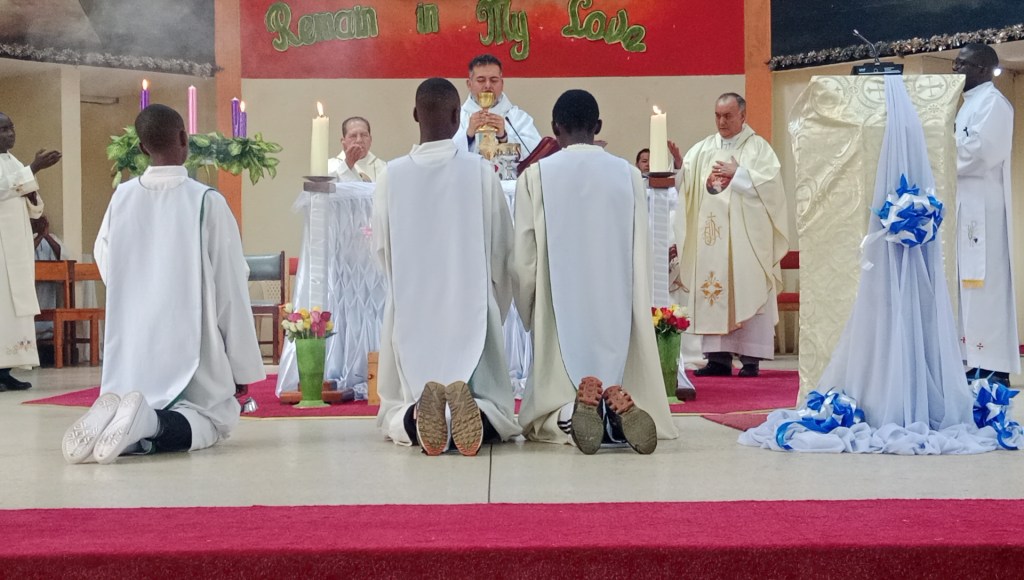
During the breaking of the Host the following is sung or said: Lamb of God, You take away the sins of the world, have mercy on us. Lamb of God, You take away the sins of the world, have mercy on us. Lamb of God, You take away the sins of the world, grant us peace.
After the Lamb of God, the people kneel.
Invitation to Communion
After his private prayers of preparation the Priest genuflects, takes the Host and, holding it slightly raised above the paten or above the chalice says aloud:
Behold the Lamb of God, behold Him who takes away the sins of the world. Blessed are those called to the supper of the Lamb.
And together with the people he adds once:
Lord, I am not worthy that You should enter under my roof, but only say the word and my soul shall be healed.
Communion
After the priest has reverently consumed the Body and Blood of Christ, Christians who are prepared come forward in reverent procession, and make a preparatory act of reverence by bowing their head in honour of Christ’s presence in the Sacrament. They receive Holy Communion standing. The Priest says:
The Body (Blood) of Christ.
The Christian replies:
Amen.
After the distribution of Communion, if appropriate, a sacred silence may be observed for a while, or a psalm or other canticle of praise or a hymn may be sung.
Prayer after Communion
Then, the Priest says:
Let us pray.
All stand and pray in silence. Then the Priest says the Prayer after Communion, at the end of which the people acclaim:
Amen.
After the Communion Prayer,
The Concluding Rites
The Concluding Rites send the people forth to walk every day in the Mystery of Christ’s Death and Resurrection and the unity in Christ which they have celebrated. Christians are encouraged to witness to Christ in the world and to bring the Gospel to the poor.
Some announcements can made before dismissal
Blessing
The Priest says:
The Lord be with you.
The people reply:
And with your spirit.
The Priest blesses the people, saying:
May Almighty God bless you, the Father, and the Son, and the Holy Spirit.
The people reply:
Amen.
Dismissal
Then the Deacon, or the Priest himself, says:
Go forth, the Mass is ended. Or: Go and announce the Gospel of the Lord. Or: Go in peace, glorifying the Lord by your life. Or: Go in peace.
The people reply:
Thanks be to God.
The Mass ends with the procession leaving church and a song.
This is a general instruction for a common Mass. Some items can be omitted or added according to the place, culture, occasion of the Roman Catholic Liturgy.


Leave a comment