
Date: November, 16
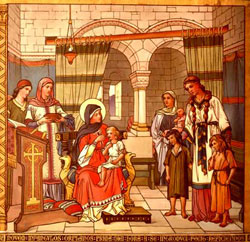
St. Margaret of Scotland, or Margaret of Wessex, was an English princess born in Hungary to Princess Agatha of Hungary and English Prince Edward the Exile around 1045. Her siblings, Cristina and Edgar the Atheling were also born in Hungary around this time.
Margaret and her family returned to England when she was 10-years-old and her father was called back as a potential successor to the throne. However, Edward died immediately after the family arrived, but Margaret and Edgar continued to reside at the English court.
Margaret’s family fled from William the Conqueror after his victory at the Battle of Hastings in 1066. Her widowed mother set out to take her children north to Northumbria.
Tradition says, Agatha decided to leave Northumbria and return to the continent, but her family’s ship got caught in a storm. The storm drove their ship even more north to Scotland, where they were shipwrecked in 1068. The spot they landed on is now known as “St. Margaret’s Hope.”
Malcolm Canmore III, the king of Scotland, welcomed Margaret and her family and put them under his protection. He soon fell deeply in love with the beautiful and kind princess. Margaret and Malcolm became married in 1070 at the castle of Dunfermline.
Together, they had eight children, six sons and two daughters. All of whom were raised with deep Catholic Christian faith. They lived as a holy family, a domestic church.
Margaret’s kind-nature and good heart was a strong influence on Malcolm’s reign. She softened his temper and helped him become a virtuous King of Scotland. Together they prayed, fed the hungry, and offered a powerful example of living faith in action. Margaret was placed in charge of all domestic affairs and was often consulted with state matters, as well.
She promoted the arts and education in Scotland. She encouraged Church synods and was involved in efforts to correct the religious abuses involving Bishops, priests and laypeople.
Her impact in Scotland led her to being referred to as, “The Pearl of Scotland.”
She constantly worked to aid the poor Scotland. She encouraged people to live a devout life, grow in prayer, and grow in holiness. She helped to build churches, including the Abbey of Dunfermline, where a relic of the true Cross is kept.
She was well-known for her deep life of prayer and piety. She set aside specific times for prayer and to read Scripture. She didn’t eat often and slept very little so she would have more time for her devotions. She lived holiness of life as a wife, mother and lay woman; truly in love with Jesus Christ.
Malcolm supported Margaret in all her endeavors and admired her religious devotion so much he had her books decorated in jewels, gold and silver. One of these decorated books, a gospel book with portraits of the four evangelists, is now kept in Oxford at the Bodleian Library after it was miraculously recovered from a river.
In 1093, Malcolm and their oldest son were killed during the Battle of Alnwick. Already ill and worn from a life full of austerity and fasting, Margaret passed away four days after her husband, on November 16, 1093.
Her body was buried before the high alter at Dunfermline.
In 1250, Pope Innocent IV canonized Margaret as a Saint, acknowledging her life of holiness and extraordinary virtue. She was honored for her work for reform of the Church and her personal holiness.
In 1259, Margaret’s and Malcolm’s bodies were transferred to a chapel in the eastern apse of Dunfermline Abbey. In 1560, Mary Queen of Scots came into possession of Margaret’s head. It was kept as a relic. She insisted that it, and Margaret’s prayers from heaven, helped assist her in childbirth. Her head later ended up with the Jesuits at the Scots’ College, Douai, France, but was lost during the French Revolution.
St. Margaret is the patron saint of Scotland.
PRAYER
O God, who made Saint Margaret of Scotland wonderful in her outstanding charity towards the poor, grant that through her intercession and example we may reflect among all humanity the image of your divine goodness.
Through our Lord Jesus Christ, your Son, who lives and reigns with you in the unity of the Holy Spirit, one God, for ever and ever. Amen
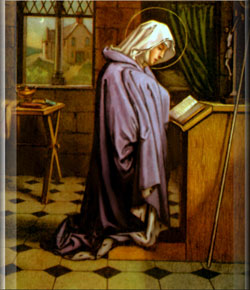
Saint Gertrude the Great or St. Gertrude of Helfta, was born on January 6, 1256 in Germany. She eventually chose to follow the Lord by pursuing a vocation as a Benedictine Nun. Her deep relationship with the Lord in prayer led to her being hailed as a mystic. She was also regarded as a great theologian.
Although little is known about Gertrude’s childhood, it is widely accepted that at just four-years-old, she was enrolled in the Cistercian monastery school of Helfta in Saxony, under the governance of Abbess Gertrude of Hackerborn.
The Cistercian movement was an effort to bring the Benedictine religious community back to a stricter and more faithful adherence to the original “Rule” or way of life encouraged by St Benedict. Some sources speculate that Gertrude’s parents offered their child as an oblate, a lay person especially dedicated to God or to God’s service, while others believe she may have entered the monastery school as an orphan.
St. Mechtilde, the younger sister of the Abbess Gertrude, took care of young Gertrude. Gertrude and Mechtilde had a strong bond that only grew deeper with time, allowing Mechtilde to have a great influence over Gertrude.
Gertrude, known for being charming and able to win people over, entered the Benedictine Order at Helfta and became a nun. She devoted herself to her studies, and received an education in many different subjects. Gertrude was both fluent in Latin and very familiar with scripture and works from the Fathers of the Church, including Augustine.
In 1281, 25-year-old Gertrude experienced her first series of visions that would continue until the day she passed away. Her visions altered her life and she saw this moment as her new birth. Her priorities turned away from secular teachings and focused more on studying Scripture and theology. Her life became full with this awakening and she was an enthusiastic student, writing for the spiritual benefit of others.
Gertrude once had a vision on the feast of John the Evangelist, described in Gertrude’s writings. As she rested her head near Jesus’ wound on his side, she could hear the beating of his heart. She asked St. John if he, too, felt the beating of Jesus’ Divine Heart on the night of the Last Supper. He told her he was saving this revelation for a time when the world needed it to rekindle its love.
She went on to become one of the great mystics of the 13th century. Along with St. Mechtilde, she practiced what is known as “nuptial mysticism,” seeing herself as the bride of Christ. She embraced charity for both rich and poor, she was a simple woman with a deep solidarity with those not yet ready for the beatific vision, who are still being purified in the state of repose known as purgatory.
Gertrude assisted at the deathbeds and mourned for the loss of both Abbess Gertrude of Hackeborn in 1291 and her dearly loved St. Mechtilde in 1298. Gertrude’s health began to deteriorate, but she continued to only show her love for the Lord.
“Until the age of 25, I was a blind and insane woman… but you, Jesus, deigned to grant me the priceless familiarity of your friendship by opening to me in every way that most noble casket of your divinity, which is your divine Heart, and offering me in great abundance all your treasures contained in it”.
On November 17, 1301, Gertrude passed away a virgin and joined her Bridegroom forever.
Throughout her life, Gertrude produced numerous writings, although only a few still exists today. One of her longest surviving works is Legatus Memorialis Abundantiae Divinae Pietatis (The Herald of Divine Love). Her other standing works include, her collection of Spiritual Exercises and Preces Gertrudianae (Gertrudian Prayers).
The Herald of Divine Love is composed of five different books. Book two is the core of the work, and was written solely by Gertrude. It is a notable piece of writing, because it includes detailed descriptions of Gertrude’s visions and a veneration of Christ’s heart. The other four books are believed to have been composed by other nuns.
Although Gertrude was never formally canonized, Rome approved a liturgical office of prayer and readings in her honor. To separate her from Abbess Gertrude of Hackeborn, Pope Benedict XIV gave her the title, “the Great,” making her the only woman saint to be called, “the Great.”
St. Gertrude the Great is the Patroness of the West Indies and she is often invoked for souls in purgatory.
PRAYER
O God, who prepared a delightful dwelling for yourself in the heart of the Virgin Saint Gertrude, graciously bring light, through her intercession, to the darkness of our hearts, that we may joyfully experience you present and at work within us.
Through our Lord Jesus Christ, your Son, who lives and reigns with you in the unity of the Holy Spirit, one God, for ever and ever. Amen
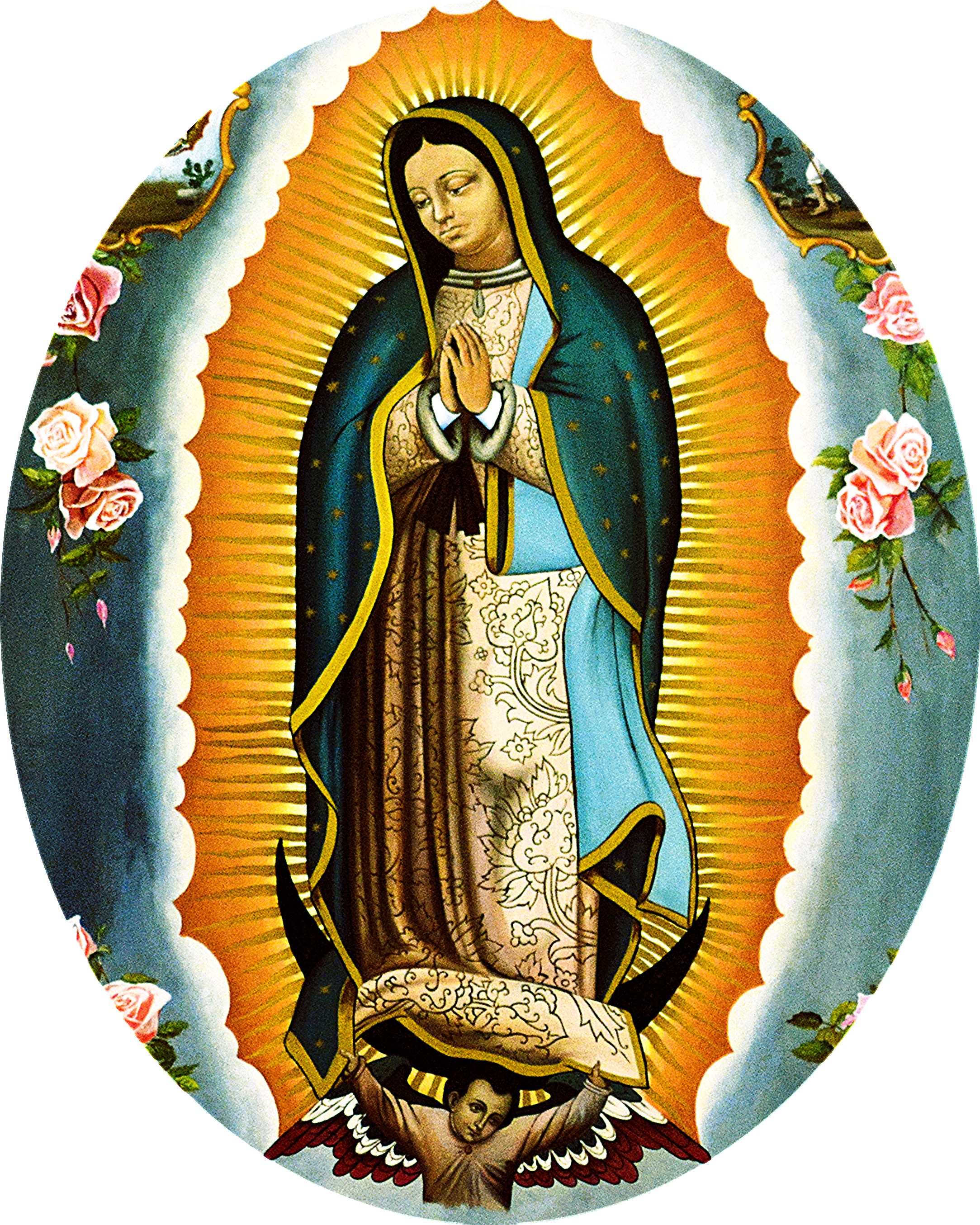
 Our Lady of Guadalupe
Leave a comment