
Date: October, 17
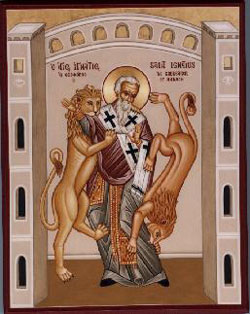
St. Ignatius of Antioch has been well-known since earliest times. He was born in the year 50. He is a precious link to the Apostles. For Christians of the early centuries, Christianity was like an explosion of light in their lives.
It was new life, something so undeserved that, notwithstanding persecution, all they could do was praise. Ignatius liked to call himself Theophoros, or “God-bearer” and was a part of the Church of the Apostolic age.
Whatever his origins, he became the second or third bishop of Antioch, in the Roman province of Syria, the city where “the disciples were for the first time called Christians” (Acts 11:26). Ignatius was a friend of St. Polycarp, who was a disciple of St. John, so it is possible that Ignatius, too, knew the beloved disciple.
Testifying to the Word made flesh
Ignatius wanted to set “Judaizing” Christians free of the Mosaic Law, for the old dispensation had been fulfilled in the new. Ignatius was a tireless witness to the Word made flesh, and saw the Incarnation as supreme testament of God’s mercy.
This testament is, first of all, that of the real body of our Lord Jesus Christ: “There is one Physician … both made and not made; God existing in flesh … even Jesus Christ our Lord.” But it is also the Church. According to Ignatius “Wherever the bishop appears, there let the people be; as wherever Jesus Christ is, there is the Catholic Church.” Finally, there is the Eucharist, which Ignatius called “the medicine of immortality.”
This bread is the Eucharist that Ignatius celebrated as bishop, but it is also the eucharist, or “thanksgiving,” that Ignatius himself would become. Writing to the Church of Rome, he asked them not to appeal his death sentence. In this extraordinary letter, Ignatius writes, “I am God’s wheat and shall be ground by [wild beasts’] teeth so that I may become Christ’s pure bread…. Do not stand in the way of my birth to real life.”
“Within me is the living water that says, deep inside me, ‘Come to the Father!’ I no longer take pleasure in perishable food… I want only God’s bread, which is the flesh of Jesus Christ … and for drink I crave his Blood, which is love that cannot perish.”
This bishop who had the testimony of the apostles reverberating in him was ground like wheat – the iconographic tradition presents him clear-eyed and serene as lions seize his body. That is how he became living bread. He desired to be, and became, a sacrifice of praise.
St. Jerome and St. John Chrysostom both thought of his tomb as near the city gates of Antioch. Ignatius was the third bishop of Antioch. Ignatius was condemned to death during the reign of Emperor Trajan. He was led from Antioch to the center of Roman cruelty-the amphitheater.
When the beloved Ignatius arrived in Rome, he joined the brave Christians who waited in prisons. The day came when the bishop was pushed out into the amphitheater. Two fierce lions devoured him. He left the beautiful witness of Christian life and his letters.
St. Ignatius died around 107. Almost everything else that we know of him comes from the seven letters he wrote after his arrest, which the historian Eusebius of Caesarea places during the reign of the Emperor Trajan, somewhere between the years 107 and 110AD.
The letters were addressed to Christian communities that Ignatius passed by as he was escorted by Roman soldiers from Antioch to Rome, where he would be fed to wild beasts. These letters are a precious testimony to the life and the faith of the Apostolic Church.
A letter to the Romans by St Ignatius of Antioch
“I am God’s wheat and shall be ground by the teeth of wild animals. I am writing to all the churches to let it be known that I will gladly die for God if only you do not stand in my way. I plead with you: show me no untimely kindness. Let me be food for the wild beasts, for they are my way to God. I am God’s wheat and shall be ground by their teeth so that I may become Christ’s pure bread.
Pray to Christ for me that the animals will be the means of making me a sacrificial victim for God. No earthly pleasures, no kingdoms of this world can benefit me in any way. I prefer death in Christ Jesus to power over the farthest limits of the earth. He who died in place of us is the one object of my quest. He who rose for our sakes is my one desire.
The time for my birth is close at hand. Forgive me, my brothers. Do not stand in the way of my birth to real life; do not wish me stillborn. My desire is to belong to God. Do not, then, hand me back to the world. Do not try to tempt me with material things. Let me attain pure light. Only on my arrival there can I be fully a human being. Give me the privilege of imitating the passion of my God. If you have him in your heart, you will understand what I wish. You will sympathize with me because you will know what urges me on.
The prince of this world is determined to lay hold of me and to undermine my will which is intent on God. Let none of you here help him; instead show yourselves on my side, which is also God’s side. Do not talk about Jesus Christ as long as you love this world. Do not harbor envious thoughts. And supposing I should see you, if then I should beg you to intervene on my behalf, do not believe what I say. Believe instead what I am now writing to you.
For though I am alive as I write to you – still – my real desire is to die. My love of this life has been crucified, and there is no yearning in me for any earthly thing. Rather within me is the living water which says deep inside me: “Come to the Father.” I no longer take pleasure in perishable food or in the delights of this world. I want only God’s bread, which is the flesh of Jesus Christ, formed of the seed of David, and for drink I crave his blood, which is love that cannot perish.
I am no longer willing to live a merely human life, and you can bring about my wish if you will. Please, then, do me this favour, so that you in turn may meet with equal kindness. Put briefly, this is my request: believe what I am saying to you. Jesus Christ himself will make it clear to you that I am saying the truth. Only truth can come from that mouth by which the Father has truly spoken.
Pray for me that I may obtain my desire. I have not written to you as a mere man would, but as one who knows the mind of God. If I am condemned to suffer, I will take it that you wish me well. If my case is postponed, I can only think that you wish me harm.”
PRAYER:
Saint Ignatius of Antioch, you were highly blessed to be part of the earliest days of the Church. You were touched by Christ, made the radical commitment to follow Him, served as a bishop, and died courageously and joyfully as a martyr.
Please pray for me, that I will discover what you discovered and believe what you believed, so that I will also long for nothing other than to be in the service of God’s will, sacrificially laying my life down. Saint Ignatius of Antioch, pray for me. Jesus, I trust in You.
 Our Lady of Guadalupe
Leave a comment