
Date: August, 2
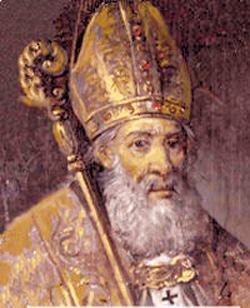
Saint Eusebius of Vercelli was born on the island of Sardinia, located in the Mediterranean Sea, west of modern-day Italy.
His birthdate remains uncertain. Some accounts suggest it was around 283, but more reliable sources propose a date after the year 300.
At the time of Eusebius’ birth, Sardinia was a province of the Roman Empire. Though Christianity had endured various persecutions in the Roman Empire up to the time of Eusebius’ birth, there was relative peace until 303 when Emperor Diocletian issued a series of edicts ordering the arrest and execution of Christians.
Some accounts of Eusebius’ early life state that his Christian father was martyred when Eusebius was young, leading him and his mother to move to Rome. There, Eusebius practiced his faith diligently, becoming a lector and a respected figure within the Catholic community.
During Eusebius’ time in Rome, a priest named Arius from Alexandria, modern-day Egypt, began to propagate a theological position that later became known as the Arian Heresy. He taught that the Son of God was not co-eternal with the Father and was inferior to Him.
To disseminate his beliefs, he frequently repeated the phrase, “there was a time when the Son was not.” This phrase became popular in songs as a means of promoting Arius’ belief among the laity. His erroneous ideas rapidly spread to various parts of the Roman Empire, causing significant division.
As a result, Emperor Constantine the Great called a Church council in Nicaea in 325 to address the issue. The Nicene Creed, which emerged from that council and is still professed today, addressed the Arian Heresy, stating, “I believe in one Lord Jesus Christ, the Only Begotten Son of God, born of the Father before all ages. God from God, Light from Light, true God from true God, begotten, not made, consubstantial with the Father…”
Despite resolving the theological debate, the heresy did not easily subside, and divisions continued. One of the staunchest defenders of the Church against this heresy was Saint Athanasius, then the Bishop of Alexandria. In 335, due to ongoing tensions, Arius and two Arian bishops manipulated Emperor Constantine the Great into exiling Bishop Athanasius from his diocese.
Around 340, Eusebius’ exemplary holiness and support for the true faith led the pope to ordain him as a bishop and appoint him as the first Bishop of Vercelli, in modern-day northern Italy. In Vercelli, Bishop Eusebius was passionate about his faith. He not only ministered to his congregation but also actively reached out to pagans, working toward their conversion.
He was the first bishop to establish a form of monastic life for diocesan clergy. The clergy lived in common but served the needs of the diocese under Bishop Eusebius, who himself lived among them. This novel approach led to fraternity, spiritual growth, accountability, and the positive outcomes of pursuing a common mission.
Following the death of Emperor Constantine the Great, his three sons co-ruled the empire. One, Constantius II, sympathized with Arianism. Consequently, in 355, Constantius II convened a council in Milan to attempt to exile Bishop Athanasius again, as well as the pope, due to their opposition to Arianism.
During the council, Bishop Eusebius and a few other bishops staunchly supported both the pope and Bishop Athanasius. As a result, the emperor forced Eusebius and the other orthodox bishops into exile.
Bishop Eusebius was first sent to Scythopolis, which is located in the Jordan Valley just south of the Sea of Galilee, then to Cappadocia in modern-day Turkey, and finally to Thebaid, Egypt, south of Cairo. Thebaid was a remote and desolate territory, and Bishop Eusebius had to endure the harsh environment, as well as abuse by his jailers.
Exile aimed to separate the shepherd from his flock, thus severing his ability to minister to them. However, the plan backfired. Like Bishop Athanasius, Bishop Eusebius became a prolific letter writer during his exile, continuing to guide his flock and encourage other bishops throughout the empire.
A few of his letters, theological treatises, and homilies have survived either in whole or in part to this day. Eusebius remained in exile until 361 when Emperor Constantius II died, and the succeeding Emperor Julian allowed all of the exiled bishops to return to their dioceses.
Reunited with his flock, Bishop Eusebius ministered to his people for ten more years until his death. During that time, he continued to defend the Nicene Creed and to oppose Arianism.
In 362, he participated in the Second Council of Alexandria, which reaffirmed the teachings of the Council of Nicaea in 325 and addressed the theological concerns of Arianism. It also declared that repentant Arians who professed the Nicene Creed could be readmitted into full communion with the Church. Thus, it served as both a theological and pastoral council.
Saint Eusebius is remembered today not only as a staunch defender of the true nature of Christ but also as a holy pastor who bravely endured exile and much suffering for his faith. For this reason, he is considered one of the great confessors of the early Church.
During his lifetime, he ministered among some of the other great confessors of the Church—a “confessor” being one who suffered for the faith but did not endure martyrdom. These included Saint Athanasius of Alexandria, Saint Basil the Great, Saint Gregory of Nazianzus, Saint Gregory of Nyssa, Saint Hilary of Poitiers, and Saint Ambrose of Milan.
As we honor this great saint and bishop, reflect on his courage that was interwoven with a profound love for his people. He endured exile and immense suffering, remaining firmly committed to his faith.
Consider ways in which God may be calling you to joyfully endure suffering for your faith. As you do so, pray for the courage that Saint Eusebius demonstrated so that you, too, can make a difference in the lives of others.
Prayer:
Saint Eusebius, you were a faithful pastor who loved his flock, cared for the clergy, and defended the divinity of Christ. For your fidelity, you suffered greatly.
Pray for me, that I will never allow suffering to deter me from my calling to share the love of Christ and to defend the truth for the good of others. Saint Eusebius of Vercelli, pray for me. Jesus, I trust in You.
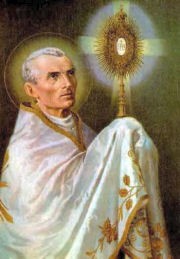
Peter Julian Eymard was born to devout parents and was the youngest of ten children, eight of whom died in infancy.
His mother, especially devout, taught him the faith well. From an early age, Peter developed a profound devotion to the Blessed Mother and the Eucharist. His devotion to the Blessed Mother was intensified as a child when he made a pilgrimage to the Marian shrine of Our Lady of Laus, where the Blessed Mother had appeared to a young shepherd girl a century earlier.
Peter’s love for the Eucharist also began at a young age. One story relates that, at the age of five, Peter was missing from home. He was found in the local church standing next to the tabernacle. When his sister asked what he was doing, he reportedly said, “I am near Jesus and I am listening to him!”
Another story relates that before Peter received his First Holy Communion, he would eagerly await his sister’s return from Holy Communion and would place his head on her heart and say, “I can feel His presence!”
Finally, when he received his First Holy Communion at the age of twelve, he promised Jesus he would become a priest. His love for our Eucharistic Lord was so intense that he could consider nothing else.
In his teenage years, Peter asked his father to allow him to become a priest, but his father initially refused. His father, an artisan who made cutlery, wanted Peter to work in the family business, especially since Peter was his only surviving son. As a result, Peter studied Latin in private to prepare himself for eventual theological studies.
In 1827, when Peter was seventeen years old, his father finally consented and Peter began to study under a hospice chaplain near Grenoble, about twenty miles from his home. The following year, his mother died and Peter returned home, partly due to his mother’s death, partly to help his father, and partly because the priest-chaplain did not teach him Latin as promised.
In 1829, at the age of nineteen, Peter moved about 150 miles south to Marseille, France, where he entered the Oblates of Mary Immaculate. Five months later, Peter became seriously ill and had to return home again.
In 1831, Peter’s father died. Peter left the family business, traveled back to Grenoble, and was reluctantly admitted to the diocesan seminary. Though he was a bit behind in his education, his zeal got him through, and he was ordained a diocesan priest on July 20, 1834, at the age of twenty-three.
As a newly ordained priest, Father Peter suffered from some health problems but was eventually able to serve as a parish priest in the countryside. In 1839, after sensing a call to religious life, he joined the Society of Mary (Marist Fathers) and a year later was assigned to the Marist College of Belley where he fulfilled the duties of preaching, religious instruction, administration of the sacraments, and acted as a liaison with pupils and parents.
After four years, Father Peter was appointed Provincial of the Society of Mary and made Visitor-General. As Visitor-General, he traveled to various Marist houses to inspect their health and fidelity to the Marist mission.
At the age of thirty-eight, during a visit to Paris in 1849, Father Peter came in contact with a group called the Association of Nocturnal Adorers, whose mission was to practice and promote perpetual adoration of Christ in the Eucharist. This was a life-changing experience for him and the beginning of the rest of his life’s work.
After some missteps, perhaps due to excess zeal, Father Peter was demoted from his position within the Marists and sent to the Marist College at La Seyne-Sur-Mer, where he served from 1851–1855. This was a period of prayerful discernment for him, and the desire began to grow within him to found an order dedicated to the Blessed Sacrament.
In 1856, despite initial strong resistance from his Marist superior, Father Peter received permission to leave the Marists and found the Congregation of the Blessed Sacrament, a new congregation dedicated to Eucharistic adoration and the fostering of this devotion.
Upon leaving the Marists, Father Peter was joined by another priest named Father Raymond de Cuers. They traveled to Paris where they sought the approval of the Archbishop of Paris. After a twelve-day hearing, conducted by the archbishop and two other bishops, the three unanimously offered their support, agreeing that his mission was the will of God.
They encouraged Peter and his order not only to promote Eucharistic adoration but also to catechize adults and prepare them for Holy Communion. Before the end of the year, despite being dirt poor, Father Peter and Father de Cuers had moved into a run-down house they rented from the archdiocese, began raising money to build a chapel that he called a “cenacle,” and welcomed two other priests and a novice as his congregation’s first members.
The congregation’s purpose was the salvation of souls and fostering devotion to the Eucharist. Their works were preaching, offering retreats, and preparing people for their First Holy Communion through catechesis.
By the beginning of 1857, they opened their chapel for adoration three days a week, and a few people came. However, within a few months, Father Peter became ill, the two priests and novice left, the archdiocese wanted the rented property back, and Father de Cuers left but returned a day later.
Though the establishment of this new congregation proved to have many difficulties, Father Peter pressed on, moved to a new location, and began again. This time he and Father de Cuers added catechesis to their ministry, exposed the Blessed Sacrament, invited the poor and the sinner to repent, adored Jesus, and encouraged frequent reception of Holy Communion.
Over the next nine years until his death, Father Peter worked tirelessly on his God-given mission. As members joined, he opened up additional houses, began a contemplative branch of his order for women called the Servants of the Blessed Sacrament, started the Priests’ Eucharistic League, intended for diocesan clergy to help them grow in and spread a love for the Eucharist, and formed a lay organization to share their mission called the Archconfraternity of the Blessed Sacrament.
When Father Peter began his work, he sensed the need to make reparation through adoration for sins committed against our Lord. As time went on, his focus included reparation but also expanded to adoration purely for the love of God and as a means to make a gift of oneself to God.
As we honor this great saint, ponder your own devotion to Christ in the Holy Eucharist. Saint Peter Eymard discovered the holiness of God, hidden behind the appearance of bread and wine. His devotion to adoration led him to catechesis about the Eucharist.
Allow him to inspire you to renew your own commitment to learning more about the Blessed Sacrament, so that you will more fully give yourself to our Lord as a total gift of yourself, out of love for God, the reparation of sin, and the salvation of souls.
Prayer:
Saint Peter Julian Eymard, God inspired within you, from an early age, a deep and unwavering love for His divine presence in the Most Holy Eucharist. You responded to that inspiration and fulfilled God’s will by spreading devotion to the Holy Eucharist far and wide.
Please pray for me, that I will more fully embark on a mission to understand God’s divine presence in the Eucharist so that I will make a continually deepening gift of myself to Him. Saint Peter Julian Eymard, pray for me. Jesus, I trust in You.
 Our Lady of Guadalupe
Leave a comment